Monday, 19 September 2011

Writing Novels and Things #11: Taking inspiration

There are certain things about writing that I find relatively easy, that others find difficult, stuff like starting projects, finding a voice, sending my stuff off to be rejected, sitting down and doing writing, stuff like that. Then there are the things that others seem to have a surfeit of, that are seemingly essential to the creative process, that I lack. One of these things is ideas.

(I am quelling the desire to justify this, so that you don't think I have nothing to say and/or shouldn't be working in a creative field. Have I also just given too much away, admitting as I have that I care what you think? As this paragraph is bracketed, I would prefer if you never mentioned having read this. Thanks!)

If I sit there at my computer and think, 'OK, let's find something for my characters to do,' I will freeze, entirely. My characters will do nothing. They'll sit around an office, or a coffee shop, or a living room, wittily, insightfully, charmingly, gazing into their navels and remarking on the world around them (and this world will, probably, be quite a lot like mine). This kind of fiction is rarely of interest to people who read things. Honestly.

So, I have learned that, for me, I must come to the empty Word document with a hook or concept, lest I write yet another moody coming-of-age tale where nothing happens (which I love, by the way, and will never stop writing). You come up with these concepts by having things called ideas. These can be found all around, and when you get these ideas from around you, it is said that you are drawing inspiration.

Mur Lafferty wrote a good little blog post about ideas and generating them. Essentially, ideas are like a magic penny, hold it tight and you wont have any, but spend it, lend it, and you'll have so many that they'll roll all over the floor. Yes, I just stole those lyrics from a song about God, but I think it works in this regard too. Basically, you're supposed to use all your ideas all the time, and don't save them up for later. You'll think of new ones. Getting the old ones out of your head and onto the page will actually clear room for new ones. This is, I think, Science.

So, in summary, in order to be a good fiction writer, you need ideas. You may well have known that already. The good thing is, prompts for ideas are all around us because we live in a world where there are so many things! One of the first assignments in my masters course was to find a picture and write a story about it. I can't find the original picture, but I'm fairly sure that it was a Studio Ghibli film still with a little girl looking at her reflection in the river. So I wrote a terrible (not in terms of subject matter, in terms of quality) story about that!

It's a good exercise, because it teaches you not to be too precious about your subject matter, and to look deeply into everything around you. If you can create a story sparked by just one little picture, what can you do with a whole world at your disposal?! Write more stories, mostly.

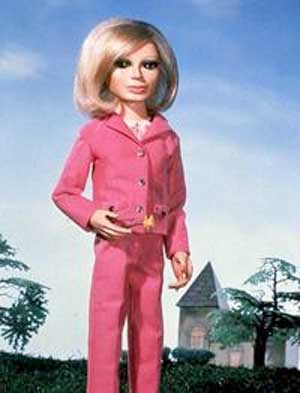
Music is good for that. Just this week, I was very inspired by an Elbow song. I haven't yet turned it in to anything, but it made me want to write a poem for the first time in ages. I then realised, while trying to write the poem, that I had no idea how to write a poem and that copying song lyrics is not the way. However, the first short story I ever got published was based on a song by Air, called Le Voyage De Penelope. It wasn't so much the song as the title; and it was a very literal interpretation. If I tell you that the title of the story ended up being Le Voyage De Lady Penelope, I think you'll get a good idea of where I went with it. I still quite like that story though, which I almost never say, modest bastard that I am.

It doesn't always work. I was fascinated by the painting below for about ten years, I even made a sculpture of it, from wire and black feathers, and have, in my head, turned her into a superhero, but I have never been able to write something about her that isn't, well, a bit rubbish.
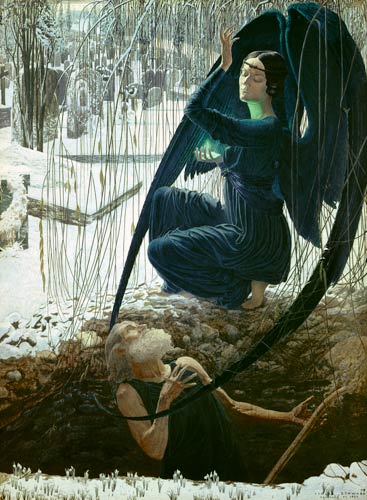

 See also: the above Elbow anecdote. they can't all be winners!

Still, this is my advice to all those struggling for ideas: steal be inspired by someone else's! You won't be sorry.

Wednesday, 7 September 2011

Writing Novels and Things #10: Write what you (don't) know

I've been meaning to write about this for ever, and I think I wrote it down in a notebook somewhere (writing tip: be organised with your notebooks - it's all very good writing things down, it's excellent, but it is only an effective planning/idea-generating exercise if you can find the notebook when it comes time to do some writing), but I lost it and had to write about short stories and stuff instead. (Another writing tip: try to avoid overly long parentheses - well the sentences between the parentheses - as these can derail the flow, and more importantly the meaning, of your sentences.)

The reason I've been wanting to write about this for ever is because the old adage.. ,

'You should write what you know,'

... is one of the pieces of advice that people love to bandy around about writing. It would be a commandment, if Creative Writing were a religion. Creative Writing is not a religion. Anyway, yes, it's a little bit of a universal truth. But is it universally true?

Not really.

I remember reading an interview with Phillip Pullman (I honestly am not in love with him or anything), where the interviewer asks him how on earth he, an old man, could get into the head of Lyra, who is, in fact, not an old man. He says this:
People often forget that there's such a thing as imagination. What imagination does is to take the things we know and play with them so they're not always recognisable.
  And then he says this:
Some people would say "Always write about what you know". I don't think that's good advice at all. Nor is the advice to write what you think people will like. I think that's just silly. We shouldn't bother about other people at all when we write. It's none of their business what we write.
He's an opinionated man.

Anyway, yes, he says is perfectly. If people genuinely wrote what they knew - their lives - and this was what publishers wanted, there would be millions of books all about boring office jobs and watching X-Factor. There be some of those, but not many.

The job of a writer is to make everything mean something. Conversations in real life rarely go anywhere, they're just to fill time or for entertainment's sake. They don't help move forward the plot of our lives, and they are filled with stutterings and affectations and repetition and stutterings and affectations... Ha! And the same goes for our actions. We make dinner and it doesn't affect our relationships. We brush our teeth and go toilet and call our mums and it doesn't mean anything.

In One of Our Thursdays is Missing by Jasper Fforde, a fictional character comes into the real world and is completely confused. So many things happen, and she can't tell if any of them are salient to the plot or if they just, you know, happen. It's impossible for her to solve the case she's working on because there are so many clues that could be meaningless. And time passes so slowly; if she wants to wait for something that's happening in an hour, she has to sit through that whole hour. In the fictional world, it take three words: 'An hour later...'

What that book, and Phillip and I am trying to say is this: fiction is not real life and real life is not fiction. And that is OK.

I'm taking quite a literally approach to the 'write what you know' maxim when I say it's rubbish. In essence there are, in fact, good things to take from it. As Phillip says, we 'take the things we know and play with them,' in fiction. You may know how feelings work, or certain professions, or certain sciences and fantasies, in the real world, but really these should just be tools that you use in forming your fiction. Like... knowing how to spell? Stuff like that. You don't, when you write fiction, write down a long list of the words that you know how to spell. That's not fiction, and neither is a blow-by-blow account of the daily minutiae of your life. Not that you were going to write that either...

And thus we get to my point. When we start writing fiction, we should start with our imaginations. We create a story. From there, everything else hangs: character, dialogue, voice, our real-life experience, word-play, sentence construction, and so on. Your reader will thank you and, I can guarantee, be much more interested in the things that you know.

(Big thanks to the articles below for reminding me that I wanted to write about this (and also for their contents, which I slightly stole).)

Writer Unboxed
The Atlantic

Monday, 5 September 2011

Griff's Fairy Tales, Part 3: Mary's Child

There was this time, where some parents were poor, and they had this daughter and they gave her away. Rather than go through standard adoption channels, they decided to give their baby daughter to Mary. Jesus' mum.

So Mary took this girl, let's call her Judy, to Heaven to live. Actual Heaven. And that was fine.

When Judy was a teenager, Mary went on a journey, a cruise, and left Judy in charge of the thirteen secret keys and the twelve allowed doors and the one forbidden door.

'You can open the twelve allowed doors, with their respective keys,' said Mary, 'but woe betide you should you open the thirteenth door with its key, which is on the same keyring as the others. You mark my words!'

'I don't even wanna open that door anyway,' said Judy, which was a lie.

'Don't lie,' said Mary, as she swooshed her blue head dress behind her shoulder, picked up her suitcase and left to join her cruise for single mothers in the Bahamas.

Twelve doors later, Judy was extremely bored. Behind each door had been some extremely evangelical old men who'd called themselves 'the Apostles'. She got enough of that with those Jehovah's Witnesses, all banging on the gates of Heaven trying to tell her how to get in to Heaven, from the outside of Heaven. She never let them in.


Judy looked at the thirteenth key, and then at the forbidden door, and then at the key, and then at the door, and then at what was behind the door, which she had just opened with the thirteenth key.


It was just God, or the Trinity of God, or something. Judy was never quite sure about how that all worked. The Trinity was pretty, certainly, and felt very omnipotent, but was more or less the same kind of thing one always found in Heaven, and did little to quench her boredom. She began to feel guilty.

Mary returned from her cruise tanned and refreshed. The moment she saw Judy's face, she knew something was wrong.

'Did you open the thirteenth door, Judy?' she asked.

'No,' said Judy, staring at her fingers which were fidgeting mercilessly.

'Yes you did.'

'No I didn't.'

'Did.'

'Didn't.'

'Did!'

'Didn't!'

'Didn't.'

'Did! Oh. Balls.'

Mary was not pleased.

'You get of my Heaven, this instance,' she said, pointing her finger to the Pearly Gates.

Judy left Heaven, and went back to the earth that spawned her. She lived on the mean streets of London for a while, surviving purely on her wits and heavenly beauty.

One day a TV producer happened to pass by and, stunned by her beauty, an idea formed. Suffice it to say, she was the subject of a very successful transformational reality TV show and soon became a gossip magazine staple, bagging herself a footballing spouse in the process. Unusual among footballers, her husband Dean was a doting husband, and exceeded even his own faithfulness expectations. They decided to start a family.

On the birth of her first son Chesney MiddleName Sprouse, Judy was visited by Jesus' mum, Mary.

'You're a grandma,' said Judy, as she handed the baby over to Mary.

'Judy,' said Mary, 'can you admit that you opened the thirteenth door?'

'God, Mum,' said Judy, blasphemously, 'I wasn't even going to bring all that stuff up, I thought Chesney would, like, reunite us or something. No, I didn't open that bloody door. If I had, I would have told you, without you tricking me into saying it.'

And with that, Mary disappeared, Chesney in tow. Judy realised she may have made a mistake.

The tabloids were all over it. The police were suspicious. Judy and Dean's marriage hit the rocks. A year on, they tried again and had another boy, and they called him Nine Jeff Sprouse.

Once more, Mary appeared at the hospital.

'Where's Chesney?' asked Judy.

'He's in Heaven,' said Mary, 'not opening doors. Speaking of which, are you willing to admit now that you opened the thirteenth door, and we can put this whole sorry mess behind us?'

'No, because it didn't happen!'

Mary disappeared. Judy looked over to Nine's crib, and knew before she saw. Nine was gone.

'But I didn't blaspheme,' she said.

Again the police and the press were intrigued. Criminal investigations were launched. Suspicion turn from potential stalkers to Judy herself. Dean didn't look at Judy the same way again.

Somehow, another child was conceived. The baby was delivered in the presence of guards, who then stood outside Judy's room, peeping in through the door frequently. Nevertheless, Mary slipped in.

'What's her name?' asked Mary.

Judy shrugged.

'Judy,' she said.

'That's rather plain,' said Mary, scooping the baby Judy into her arms.

'Didn't seem much point,' said adult Judy, as she prepared for her third baby to disappear.

'Judy,' said Mary, 'stop being a whiny little bitch. Just tell me.'

Judy, knowing exactly what Mary wanted to hear, but finding herself so very full of rage and shame, said nothing. It was the silence of realisation, and that realisation was this: she had nobody to blame and couldn't bring herself to make things right.

Mary disappeared with baby Judy.

Adult Judy was arrested, there was nothing anyone could do. She refused to speak when interrogated, refused to profess any innocence, and eventually that convince a jury of Guilt, and it set a precedent.


As she was lead away to the cells, stripped of all her clothes and given the prison garments, she whispered, under her breath:

'I opened the thirteenth door. I'm sorry.'

She woke up in bed, her own. Beside her were three babies, and she recognised them all, despite their uniformly baby-like Winston Churchill faces, as Chesney, Nine and baby Judy. They were all a day old. Dean lay beside the babies. They had a very big bed.

Saturday, 3 September 2011

Mister Rhys Mysteries, Case #9: Atlantis!

It is a recorded fact that water takes up at least 5% of the earth's surface, but that we know less about the ocean's depths than we do about space and aliens and the future. We know that there are fish in it, and sea 'mammals', and Nazi submarines, and some think there is pollution in it, but what about people?

There are loads of humans living on land - surely, logically, this means that there must also be people living underwater? (And I don't mean animals that supposedly think like people, like dolphins and mermaids, I mean actual human beings.) It just stands to reason.

Well Plato thought so too, so he made up presented his findings on the matter thousands of years ago, when he told us the history of Atlantis, which is an island that was as big as Libya and Asia combined, which sank into the water and became lost. He doesn't mention that the people quickly involved into sea dwellers, capable of breathing underwater and of surviving the crushing pressure of the ocean depths, but it is implied.

So what have the Atlanteans been doing in the last few millennia? And what do they look like?

There are theories, mostly in comics.


Well, as all conspiracy theorists worth their salt (water - ha!) are aware, there is no such thing as coincidence. Clearly, there are two things that unite the disparate images of sea-dwelling people: a green and gold colour scheme, and forks.

'But surely gold and green just go with water blues!' I hear cynics cry.  'And the forks are tridents, inspired by the Poseidon myth!'

The sad thing about such cynics is their unquestioning and smug belief that theirs is the only opinion that matters. They won't ever believe the theory I'm about to posit. But think about it... think about it.

So, gold and green, what does that remind you of?


Capitalism, perhaps? Imperialism, maybe? Greed?

And what about the fork? Well, that just goes without saying...
 
Ever heard of Sodom and Gomorrah? This, in my theory, is the fate that befell the Atlanteans. They were an avaricious race, and the seas ate them up as punishment. Strangely, though, they survived, and lived on... just underwater. Maybe they learnt their lesson?

There have been a number of hunts for Atlantis, notably by the notoriously gullible Nazi party. Nothing has come up, per se, but one can't discount popular culture entirely from telling the truth that is yet to be uncovered.

Atlantis exists; we just haven't looked in the right place yet.

CASE CLOSED


Friday, 2 September 2011

Working From Home Forever: A downside

People think it's so sexy, working from home. Like how I don't have to get dressed every day. And how some days I don't shower until the afternoon. Sometimes I don't even brush my teeth until I've had lunch! Maybe sexy isn't the right word...

Anyway, I have now discovered the one thing that is not good about working from home and it is this: I am poorly but I still have to go to work!

I just did not see this coming; I'm never sick! Yes, I have complaints on occasion, you know: migraines, backache, a suspicious looking freckle, dry skin, oily skin, spotty skin, inconsistently coloured skin, sore feet, a deep sense of ennui, itchy elbows, excess eyebrow skin, tummy aches, stuff like that. But I just don't get sick.

In the three and a bit years that I've been in my job, I think maybe I've taken two days off work with a serious bed-binding illness and when I returned to work people agreed that I had come back too soon and that I was helping no-one. That's just the kind of guy I am!

This week, I have been sick. It started with a sore throat, and then there was all this mucus, and finally these crazy headaches that wouldn't let up even when I was sleeping. At first, I wondered if this was because I'd forgotten to buy coffee and had to exist that day purely on green tea and lovely, caffeinated Lemsip. But then I got some coffee and the headaches got even worse. In fact, that was around the time that the nausea and high temperatures fully kicked in.

I think it might have been just a bug.

Anyway, this brings me to my complaint about working from home. You kind of don't have an excuse not to turn up to the office. I mean, I have to pass it to go to the loo at the very least, and with the modern wonder that is my laptop, I could even do it from bed.

So I worked for three days with a temperature and in pain, and it wasn't the worst thing that happened. It definitely made me grumpy and a bit short with people, but that could, potentially, be mistaken for efficiency and fast decision making; it made me not give a shit about answering my emails, which meant that I actually got a lot of things done.

The worst thing, when I think about it, is that nobody even noticed. If I didn't live with my boyfriend, I would probably be having dark fantasies right now, about my neighbours eventually finding my body, eaten from the inside out by woodlice.

That reminds me, I must go feed the woodlice...


Monday, 29 August 2011

Mister Rhys Mystery, Case #8: Winchester Mystery House

Unfortunately, this post does not take place in Hampshire. I would love to write a piece entirely devoted the town that once housed the UK's fattest teenager, but, in effect, there is absolutely nothing to say about Winchester. If anything, the real mystery is this: when will something happen, and why is everyone so old? (I realise that this is two mysteries). But someone greater than me will have to answer that. Which means it will never be answered!

HA!

No, this post is about the American Winchester, which is not a place but a surname. And a gun (named after the surname). This is a Winchester Repeater Rifle:


You will be familiar with it if you have no life. Well this gun was invented by a Mr Lieutenant Governor Winchester, whose son married a woman, if you can imagine, and she was called Sarah Winchester (post marriage, obviously). I won't bother telling you her husband's name because he only goes and dies right at the beginning of the story. Actually, before that, their baby daughter dies too. I promise that this is the darkest, saddest part of the story, if you don't count ghost legions and mental illness.
[This all happened many years ago by-the-by, so please do not request 'sources' or 'fact-checking'; everyone involved is dead and you can't prove anything.]

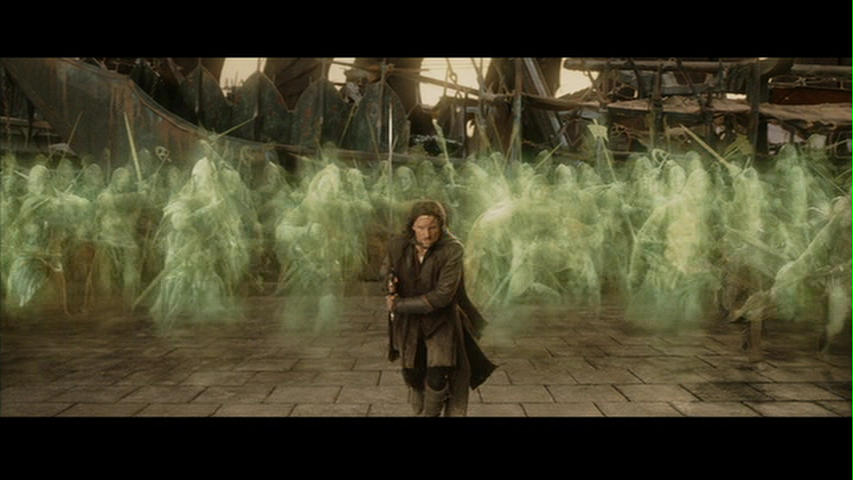
Well, after her family all died, Sarah Winchester did a bit of a Cherie, and took some advice from a spiritualist who 'helped her realise' that the Winchester family fortune was being haunted by the souls of all those who had been killed by Winchester Repeater Rifles, which was about three quarters of the world's population, ever. The haunting looked like this:


But with less Aragorn and many more Red Indians. These days, Red Indians are called Native Americans and they are not ghosts.

Well, Sarah decides that she doesn't want this haunted fortune, and that she must spend all of the money on a worthwhile project. Her spiritual advisor, and possibly some angels, told her that she should build a house! In California! It is very sad indeed that they told her to build the house in sunny California, rather than, say, Hampshire - very sad indeed!

Anyway, so she built this house, in California, and she did a good job and paid her builders very well for it. When she was finished, her fortune still felt pretty haunted so, she thought, best keep on building! So she added some extensions to the side. And then to the top. And then about five more times to the top. What had been an eight-room house (which... is a fair amount of rooms for one old widow), turned into a seven story mansion! And that took about 25 years all in, most of her adult life.

The interesting things about the house, other than Sarah's bizarre compulsion to build and build and build on it, is that the house made very little architectural sense. Staircases would lead to the ceiling, doors opened out into brick walls, there were no mirrors in the whole house, there's a Hall of Fires and a Seance Room! What on earth was she building? And why?

Well the obvious answer is that she was a distraught widow, trying to cope with a kind of Survivor's Guilt by trying to spend away all of the money she'd married in to, desperately hoping to buy back the lives of her father and child.

PFFT.

It's ghosts, isn't it? She was building them a place to live. Those doorways covered in brick? No trouble for a ghost! Same with the stairways leading into ceilings. Lack of mirrors? That's a ghost thing. Or is that vampires? Both? And the Seance Room and Hall of Fires speak for themselves! That's just the ghostly, olden-days equivalent of, respectively, a conference room and, um, a hall of fires. They made her do it, clearly, and they'll make you do it too, if you get rich. Never. Get. Rich.

CASE CLOSED

Tuesday, 23 August 2011

Writing Novels and Things #9: Short stories, Part 2

So my last post may have been all about how pointless it is to write short stories, but this post is all about how to write short stories! I am breaking you down in order to build you up. Using a combination of my own experience, my creative writing history and the internet, I have compiled a list of five rules that you should always obey when writing short stories. They are, I am happy to say, quite prescriptive.

The rules are in no particular order, so I haven't numbered them. Please do let me know if bullet points aren't enough and you would prefer them in numerical order of importance. Onwards!

Try not to feature too many characters
    I hate this rule, personally, because I like to have loads of characters in all my stories; I love them (and they love me). However, editors like this rule, I think, and so do readers. There needs to be one main character and one significant foil character and that's about it. You can, of course, have other plot-piece characters come along, but the idea is to keep these to a minimum and don't give them undue narrative attention. The longer your story, the more flexible you can be with this rule but I think it serves as a good guideline when you're creating a story. You are, of course, in charge of the story, so if you really try, you can keep the character tally down to publishable levels.

    [The last short story I wrote had three main characters and two prominent supporting characters. I wanted it to be a novel, really, which is why it will probably never see the light of day as a short story.]

    You don't need to resolve everything
      But there does need to be resolution. Short stories are often small moments in time, little windows into the characters lives, that you know are going to change them forever. But we don't need to add epilogues or neatly sew everything up in order to satisfy the reader. They will get that things are different now, if you have laid the correct groundwork. There does need to be a resolution, of course, and all the better if it links back to the beginning, or moments throughout the rest of the story (thematically, with imagery, or dialogue, however you like), but this isn't a novel, where all plots, sub-plots and so on need a proper ending. In a novel, the couple may end up getting back together, whereas in a short story, we can be satisfied if the potential for this is alluded to without, you know, a big sloppy kiss. That's a crude example, but hopefully that serves as a decent example.

      [I can think of a number of strong examples that disprove this rule, but I don't think any of them would have been harmed by following it. So... I stand by it.]

      Know what your characters want (at the very least)
        We should, we fiction writers, know our characters intimately. Or, at the very least, we need to know them better than the reader. You can find forms online, to help you create a character, and it's usually two pages of things like hair colour, age, hobbies and pastimes, middle name, birthplace, pets?, and so on. For a novel, I think these are a great idea, and moreover, I think it's good to write first-person monologues for all your main characters, so you start thinking as they think. For a short story, that feels like quite a lot of effort (and I see no need for physical description, almost ever, but that's a preference, not a rule). The most important thing you must know about a character is what they want, and why, and write it down and stick it somewhere visible while you're writing. It's the driving force of your whole story.

        [In the first short story I had published, I knew nothing of this but subconsciously, I had a very clear idea of the main character's motivations, so it worked. It does not always work, believe me. Eventually, it will become automatic, but until then it's something you should force yourself to remember.]

        Tell a story

        Which is my way of saying that you should structure your story like it's a story (see handy diagram). This is called the Five Act Structure and was invented by some guy called Freytag. It's a perfectly good structure to follow and, to all intents and purposes, still allows for an infinite number of story possibilities. However, in a short story, the Exposition bit should be super short, if non-existent, because you don't have time to waste. You should, really, begin at the point of Rising Action, though sometimes a little scene setting is required, so I will be lenient and say that you don't have to if you don't want to (but you should). There is also the Three Act Structure, which was invented by Aristotle and is comprised of the Setup, the Confrontation and the Resolution. Everything I said above still holds, but with two fewer acts.

        [I find structure the hardest bit about writing but this is likely because it is probably the most important aspect of story telling. You should always be thinking about it, even if it's not a predefined one like I've given above, you can't just put the words down in any old order. Unless you're writing a blog. Self-zing!]

        Try to get it published

        You might as well. You also may as well try to get it published by the most well-respected, high-profile publisher of the kind of short stories that you write. If it's literary, for example, just send it to Granta Magazine. You never know! And then when you have experienced rejection (which will lead to most excellent personal growth), try other publishers who are more willing to take a punt on a newcomer. It's best to go for the ones that pay, but not vital (or even possible, depending on what kind of story you are writing), and I think the joy of getting published will doubtless override... um... poverty.

        [Please see previous post for depressing news about writing short stories.]